The opening part of a movie or novel sets the tone and provides the framework. It is loaded with clues and symbolism, the essential baggage with which the plot leaves the station. Significantly, the narrative unfolds in subtle variations of or in contrast to the introductory material. The story may come full circle or conclude in opposition. Below is a reading of the opening segment of the Godfather. It covers the movie to the closing of the wedding scene.
Michael Corleone arrives at his sister Connie’s wedding in his military uniform. His status, represented by his very appearance, sets him apart from the family. He’s something of a family black sheep for being a mainstream white sheep. In contrast to Michael’s position in society, there is Sonny Corleone’s overt hostility to the Feds. Michael and Sonny belong on opposite sides of the law, but then, organized crime is less about lawmen vs outlaws than the grey zone between hypocritical virtue and corrupting vice. Gangsters aren’t radicals, or Tony Montana(of SCARFACE) isn’t Che Guevara; they break the law but have no desire to upend the order. They just want a bigger piece of the pie and grab for it with bigger balls. As Barzini later says at a meeting among the bosses, “We are not communists.”
At any rate, there’s another significance to Michael’s soldierly image: He’s a fighter whose predilections are essentially toward order, discipline, sense of duty & honor, and a powerful sense of loyalty. The characteristics that served him well in the US Marines could just as well serve the Family. In defying his father and fighting for his country, Michael exhibited a shift in priorities but not in qualities.
Indeed, it’s not long before he serves as a foot-soldier for the Family by mowing down police captain McClusky and the dope dealer Sollozo the ‘Turk’. (Then, in his exile in Sicily, he feels at ease with two men with shotguns slung over their shoulders. And upon Sonny’s death, he rises to generalship in the Family.) Sonny patronizes Michael as a ‘civilian’, but Michael has always been a member of the warrior caste who knows how to fight with both mind and body, a concept of manhood somewhat unfamiliar with Sonny who relies too much on guns and muscle.
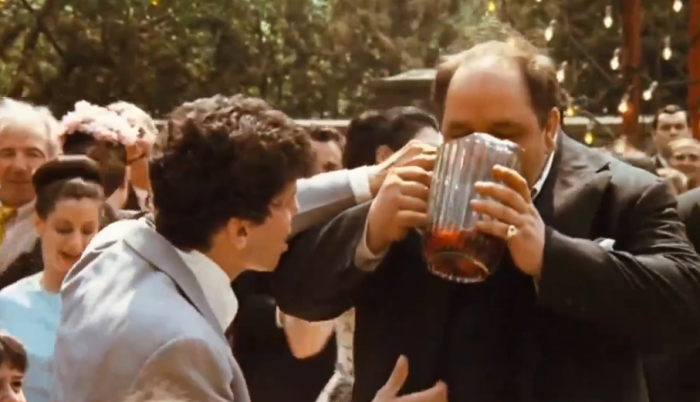
The opening segment lays out several different and contrasting notions of manhood. There’s the power of Sonny, the BIG MAN of the family. He attracts women with his raw masculinity. He’s a big strong guy, athletic, loud and brash. Somewhat similar is the manhood of Johnny Fontane who relies on looks, charm, and sensuality to win affection and adoration. Such prowess comes and goes, has its peak then burns out, much like the rollercoaster career of athletes.
(The other kind of manhood is, of course, more mindful and strategic — no wonder Hyman Roth of THE GODFATHER PART 2 is formidable even in his physically withered state.) Despite his limited presence in the movie, Johnny Fontane occupies a key role because it is through him that we see the linkage between two old men with similar understanding of power: Don Vito Corleone and the Hollywood mogul Woltz. (Fontane is later situated between the rising stars Moe Green and Michael Corleone in the great game for Las Vegas.)
Neither Vito Corleone nor Woltz has to command the main stage and make a show of themselves, like hothead Sonny or head-turner Fontane; rather, they are the pullers of stringers.
Yet, there is a key difference that gives Vito the upper hand over Woltz. Vito is a sober family man. Though his business is gambling, he isn’t a gambler. He knows the difference between risk, a matter of calculation, and gamble, a matter of carelessness. He certainly doesn’t gamble with emotions. Vito believes a man of worth mustn’t succumb to animal lusts that can easily unhinge his equilibrium and cloud his judgment. Man must think in terms of honor & fortitude and maintain a clear division between family and business.
Business is a matter of wheeling and dealing, of compromise. Family, in contrast, revolves around loyalty and fixed values. Vito’s sexual philosophy is not to be confused with repressed Victorianism or Catholic dogmatism; it is really a matter of balance and (self)control, without which men are easily led astray; after all, mythology and history are rife with examples of men losing their bearings over women, from the war over Helen of Troy to Mark Anthony’s doom with Cleopatra.
Vito harbors doubts about Sonny for muddying up what should be a clear division between family life and business by slapping his man-meat around. Emotionally and physically, Sonny makes himself vulnerable and even risks losing respect among his men, rather like Ted Kennedy’s sexual peccadillos turning off even his staunchest supporters.
Woltz may be Vito’s equal in many ways but is closer to Sonny on sexual matters. Woltz’s sexual vanity makes him rash and childish, endangering the empire he’s created. Woltz is excessively ‘personal’ over Fontane’s stealing his girl, letting the humiliation get the better of him; he’s deluded enough to think women are attracted to him for something other than money. He rants about his handmade goddess being soiled by Fontane when his business is trading in whores(not unlike what Tataglia the ‘pimp’ does).
He thinks he’s hot stuff. He lost his balance over Fontane’s eloping with his ‘piece of ass’. This is something that Vito would never allow in his own life; emotionally involving himself with a ‘piece of ass’ and then getting all butt-hurt over losing it. Vito’s ‘wisdom’ is his understanding that greatness is built on limits, not boundless megalomania. He understands that business is ruthless, chaotic, and corrupting; against these factors, a man needs a sanctuary of peace and stability immune to the ups and downs of the impersonal world. He needs a family and must fulfill his duties as the family patriarch; preferably, a family with a housewife for she preserves from the inside what the man provides from the outside.
Woltz, who could have accepted Vito’s offer and gained something in return, instead blows up like a child crying over spilled milk. He can’t control or suppress his silly sexual jealousy, blind as ever to the stupidity of having invested so much in a harlot. He says a man in his position cannot be made to look ‘ridiculous’, but he needs no help in that department in Tom Hagen’s eyes.
A tail that grows long enough will be stepped on, and same goes for the dong. Or, to modify an aphorism from Fistful of Dollars, ‘When a man with an unzipped fly meets a man with a zipped fly, the man with an unzipped fly is a dead man’, or at least a man with a dead horse in his bed.
The idea of sexuality as strength and weakness is developed throughout movie. It’s a strength in that sexual prowess can earn a man adoration from women and admiration(and envy)from men. It’s a weakness in that men may become distracted from their obligations and priorities. Woltz even ignores the fact that women are attracted to him only for his power and wealth, thus clouding his judgment. Woltz the Freudian creature is no match for Vito the Machiavellian.
Even the cold and rational Michael succumbs to the power of love in Sicily. In an instant, he forgets all about Kay. Unlike the other sexual relations in the movie, his feelings for Apollonia go beyond affection, sociability, status & class, sexual desire, ethnicity, and strategy(like the marriage among the aristocrats). Apollonia has an overwhelming impact on Michael who is struck with feelings beyond his power of reason and intellect, indeed emotions he wasn’t aware he was capable of. Kay is nice and pretty, and they made a nice pair, but just one glance makes Michael fall completely for her. She’s Sicilian but said to be almost ‘Greek’ in appearance, suggesting a timeless mythic quality.
Though the hit on Michael fails in Sicily, it is partly successful in that a part of him dies with Apollonia; and even though we don’t hear anything more about her(until THE GODFATHER PART 3), Michael is surely haunted by guilt as she died in his stead, much like the bomb that killed Darya Dugina than her father, the intended target.
Apollonia, like the monstrous opposite Luca Brasi, suggests there is a power beyond rationality and ‘business’, something irrational and obsessive(therefore inherently dangerous) but, if channeled constructively, inspiring or intimidating. The problem with Michael and Kay’s marriage is it’s too much like ‘business’, especially as Michael ‘settled for’ Kay after he lost Apollonia. It might have been different had he never known Apollonia as Kay would have been his first true love. But post-Apollonia, Kay is just good wife material. As Apollonia is above ‘business’, Luca Brasi is below it. He isn’t a gangster but a monster, a creature out of ancient mythology, which is why Vito, for all his dread and trepidation, finds him indispensable for certain jobs.
At any rate, it’s a sign of Michael’s strength and intelligence that, despite having bee hit with a bolt of lighting(or Cupid’s arrow), he maintains his composure and doesn’t lose his head over the girl. He patiently goes about to sanctify the matter, make it respectable, and lay the foundation for a stable long-lasting marriage with the blessings of all involved.
If Sonny doesn’t love his wife enough, one senses Mike loves Apollonia too much; when she dies, something dies in him, and his second courtship of Kay sounds more like a business proposition than an expression of true love. His words betray a certain degree of exhaustion, resignation, acceptance of less after losing what mattered most in his life.
Perhaps, Vito’s emotional discipline is rooted in his childhood, when in one fell swoop he lost his entire family and then found himself in a world of strangers in the New World. He was too busy trying to survive and give his life some semblance of order and stability to indulge in passion for anything or anyone. Vito, judging from THE GODFATHER PART 2(where Robert DeNiro plays the younger man), feels gratitude for what he has and loves his wife and is a stranger to deep, all-consuming passions of whatever kind. Even his ‘personal’ act, the vengeance on the man who murdered his family, is mixed with ‘business’. It was partly about alliances and territory.
Anyway, Vito’s humiliation of Woltz serves not only as a favor to Fontane but as a lesson for the Hollywood Mogul on how not to be stupid. Vito offered help in matters of ‘business’ in exchange for something so trivial(giving a movie role to Fontane), but Woltz acted like a child by mixing the ‘personal’ with ‘business’. Smart players should know that betrayal is part of business and just get on with life, but Woltz invested not only time and money in some bimbo starlet but his emotions and pride as well. After what’s done is done, the scene cuts from Woltz’s hysterics before a horse’s head to Vito’s calm and amused demeanor. Vito waltzes around Woltz with too many character warts.
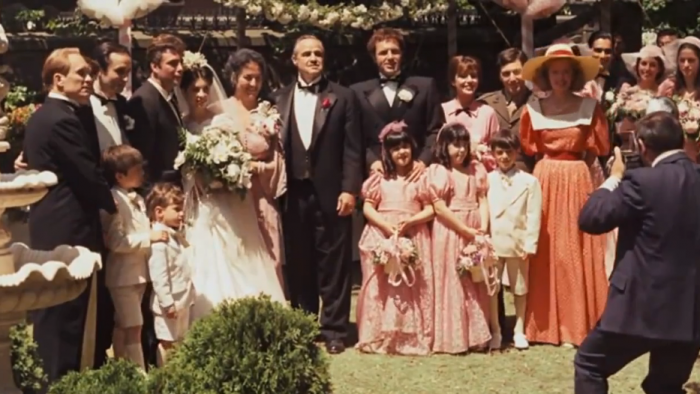
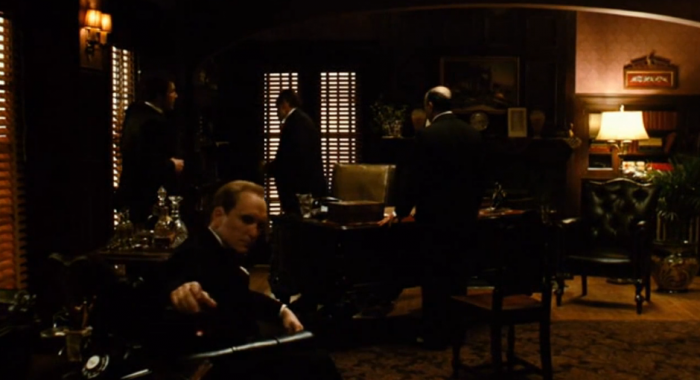
Vito later tells Michael that serious men, unlike women and children, can’t afford to be careless. This is evident in the opening segment where most people are singing, dancing, and celebrating, whereas Vito, in contrast, puts business before pleasure in his dim-lit vampiric den. When he steps out, it’s to greet other Dons like Barzini and dance with his wife. And later to take a family photo and to dance with his daughter. He stays aloof of the circus atmosphere. Vito delays the first family photo shoot because Michael hasn’t arrived. He’s careful with details and won’t settle for less unless absolutely necessary. He believes in patience and diligence because the devil in in the details when one must be ruthless. Vito’s refusal to take the family photo just then also foreshadows how Michael is later drawn back into the family, how his life becomes framed within the world created by his father.
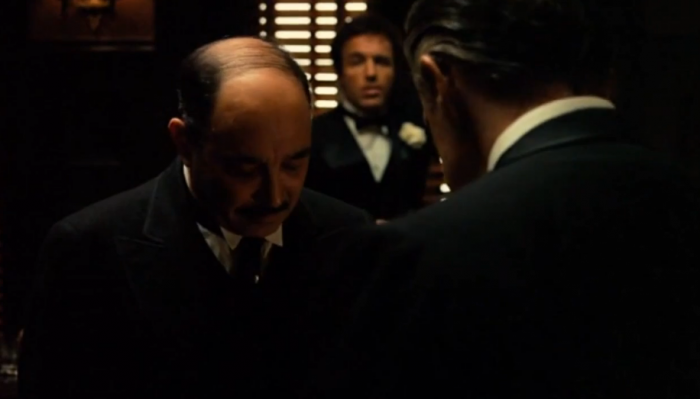
Still, Vito is only human, illustrated by his relationship with the undertaker Bonasera, the first character shown in the movie, which begins with Bonasera pleading with the Don for ‘justice’. Vito listens to him patiently but with quiet contempt. Bonasera cuts a pathetic figure, like an ant crawling before Vito. Bonasera’s business is death, but Vito is the one with the power of life and death. When asked to kill the boys who harmed Bonasera’s daughter, Vito exercises veto power over who lives or dies(further emphasized by his sheer will to live following a frightful assassination attempt that would have killed most men). Still, the limitations of Vito, his ultimate mortal status, comes later in striking contrast to the undertaker’s begging for help. With Sonny’s death, it’s Vito who is rendered helpless and pathetic, beseeching the funeral director to summon all his powers to make Sonny presentable at the funeral. By the way whereas the undertaker’s daughter had kept her honor and survived, Sonny never had much honor as a husband and ended up dead.
Bonasera the undertaker’s plea sets the tone for the entire movie, which revolves around vengeance. Mike, Sonny, Connie, Carlo, and daddy Tataglia all want to get even at one point or another.
Bonasera the undertaker also introduces the thorny theme of ethnic tensions in American society. He says he wanted to be a good American and allowed his daughter to associate with presumably WASP boys, but alas they treated her like a greaseball. (She kept her honor, and perhaps Vito has more respect for her than for her spineless father who, in his petty desire to be a respectable American, forsook the Sicilian sense of bond and loyalty, playing the whore to the Waspy ‘pezzanovantes’).
That her jaw was broken by non-Italian boys is echoed in what happens to Michael at the hands of Irish cop McClusky. If the undertaker’s predicament shows the darker side of ethnic relations, there’s a lighter side with the arrival of Kay with Michael. With her light brown hair and pale complexion, she sits in contrast to the dark-haired, greasy, and swarthy Italian-Americans.
In an America of the post war period where WASPS still reigned supreme, an Italian girl(like Bonasera’s daughter) could easily be just a plaything for privileged WASP boys. To an Italian-American male like Michael, however, a WASP woman is a prize, a symbol of upward mobility. Michael’s love for Kay is genuine, but she’s more than just an individual; she represents respectability and progress. As Jenny, the Italian Catholic, says to rich WASP Oliver in LOVE STORY: “I love not only you, but also your name and your numeral.” Michael’s feelings for Apollonia, in contrast, go beyond all such considerations.
Of Tom Hagen, Mike explains to Kay how he became part of the Family, even being considered for the special role of consiglieri. It’s in marked contrast to the brutality of the undertaker’s account of ethnic tensions. Yet, Tom is an anomaly in the Family; for one, Vito insisted Tom keep his original last name, apparently in respect to his ancestry but possibly as a reminder that one is a true Sicilian only by blood. (Ironically, Vito’s real last name isn’t Corleone, but it’s somewhat appropriate as he comes to represent an archetype of a cultural community, a time and place, than a mere individual.)
Vito shakes befriends anyone of whatever background; he’s not a man predisposed to blind prejudices. But, he is a man of deep suspicions and devoid of illusions about human nature and ethnic politics; then, it’s no wonder we hear him tell Hagen to contact some “Jew Congressman”, who, by the way, probably calls Vito a ‘dago’ or ‘greaseball’ behind his back. Still, where there’s ‘business’ to be done, it’s smiles and handshakes. At least among Vito’s generational peers, different ethnic groups did business but kept a certain distance. As a mafia chieftain says later in the movie on the matter of dope-dealing, “We’ll keep the traffic among the colored. They are animals anyway so let them lose their souls.”
Yet, there is a built-in contradiction in the Sicilian cultural value system. On the one hand, its loyalty and clannishness serve as basis for strength. But, because loyalties are so narrow and deep, divisions within the Italian-American community grow worse. Corleones and the Five Families are like fratricidal Italian principalities, sometimes bleeding one another dry, even as they try to unite against the hostile machinations of the Irish, the Jews, and the WASPS.
It is further complicated by the notion of ‘family’ in THE GODFATHER. Vito believes personal loyalty belongs within the family; outside the family, it’s ‘business’, a matter of opportunism and convenience but never deep-seated loyalty. But the larger meaning of ‘Family’ includes non-family members who serve the Corleones. Tom Hagen perhaps best epitomizes this tension for he’s not Italian but treated like a son. But, what about Clemenza, Sal, and and other chieftains? To what extent are they business associates or members of the ‘Family’? Sal and Clemenza are almost like uncles to Sonny, Michael, and Fredo(who later betrays the Family worse than anyone for sake of ‘business’, but then it turns out to be ‘personal’, which could be even more deadly). The very notion of ‘godfather’ suggests Vito feels as a patriarch over a certain Sicilian community in New York. Thus, Family Loyalty makes for ruthless machinations but also a certain sentimentality. (We see Sal dancing with some girl who stands on his shoes. This suggests that Sal will be stepped on by Michael whom Sal watched grow up since childhood: “I always liked the kid”.)
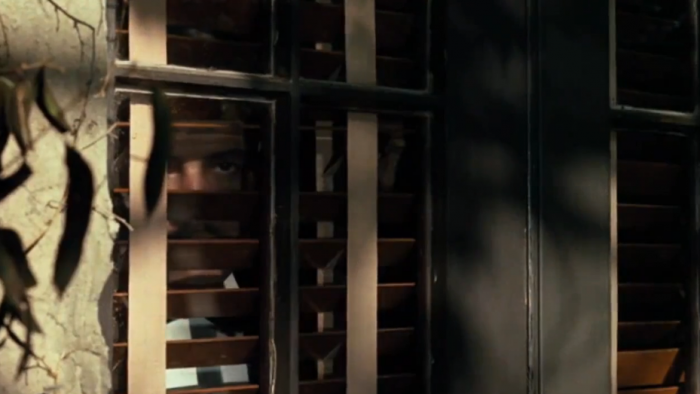
Carlo isn’t much of a character(and doesn’t have much character); however, he’s a crucial figure because he’s the bridge between festive hope & joy and death & tragedy for all involved. The movie begins with a wedding, and everyone seems to having a great time. It looks like the American Immigrant Dream. Carlo, a handsome nobody, is marrying into a top underworld family, and Connie is mad about Carlo. The other Families at the gathering seem at peace. Indeed, the scene could make a great HAPPY ending.
Yet, everything unravels soon afterwards. Contrast the festive spirit of the opening scene with the solemn atmosphere of the baptism of Carlo’s son juxtaposed with the baptism-in-blood of the heads of the Five Families. Near the end of the movie, Carlo thinks he has made it, indeed outsmarted everyone. True, he’d been upset that the Corleones kept him at the margins and took out his frustration by cheating on Connie and sometimes beating her up. And, when Sonny pushed him too far, he had a vendetta of his own and ‘fingered’ Sonny. But, he did change and come around(and win back Connie’s love), and Michael appointed him to a key position in the family, a case of keep-your-friends-close-but-your-enemies-closer. He became a devoted husband, and Connie forgave him. Connie and Carlo came full circle, back to hope and happiness.
But then, Michael kills him and Connie goes mad and ruins her life, as depicted in THE GODFATHER PART 2.
This other tragedy of THE GODFATHER is generally overlooked because the main focus is on the moral tragedy of Michael, plus the fact that most people don’t much sympathize men who hit women(but then, even Michael finds himself striking Kay after she killed the kid in THE GODFATHER PART 2).
But then, as Vito might have said, Carlo never would have gotten into that situation had he kept his fly zipped as his infidelity unwittingly set into motion a series of events. His fooling around led to angry Connie which led to black & blue Connie which led to Sonny seeing black & blue Connie which led to angry Sonny beating Carlo black & blue which led to black & blue Carlo setting up Sonny, so that when Carlo once again beat Connie black & blue, it led to angry Sonny being turned black, blue, & red, which then led to angry Michael whose men turned Carlo blue in the face. The Moral: Keep your fly zipped. One should note, however, that both Carlo and Connie are pushed to do something against their nature, respectively betraying Sonny and ‘ratting’ on Carlo to her brother, only when pushed beyond the limits of their endurance.
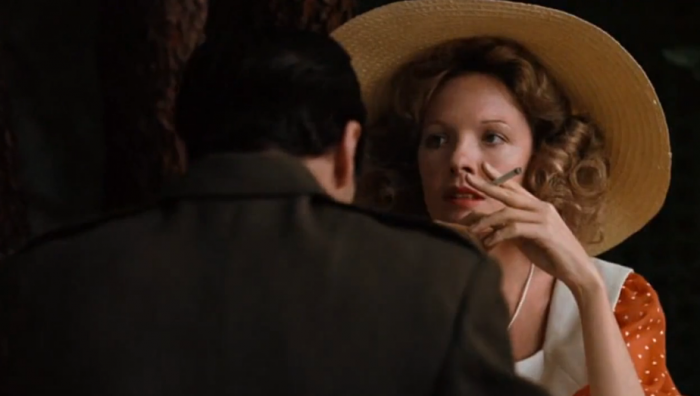
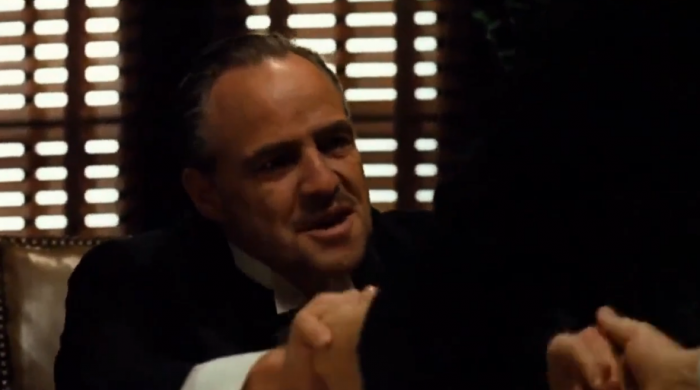
The opening also lays out the differences among the main players, the central contrast being between Vito and Sonny. The more we watch, more we wonder how this guy Sonny is be the heir to his father’s empire. Vito is at once economical and graceful; he doesn’t waste a single word or movement. Even his stroking of the cat communicates plenty. His actions are like Strunk-and-White’s advice on grammar applied to life.
Sonny, in contrast, is a busybody, unfocused, bullheaded, easily distracted, the locus of his attention being his penis than his head. Sonny is a man of some intelligence but can’t use it intelligently as his emotions usually outpace his mind.
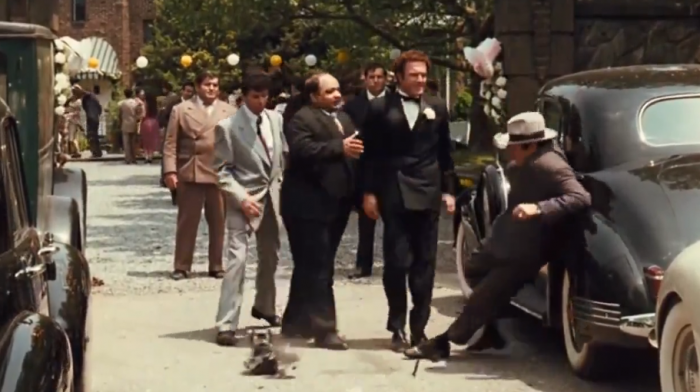
Vito is later said to have politicians like so many coins in his pocket, but he also knows the value of each coin. Sonny, however, is a waster of energy. His casual tossing of few bucks from his pocket after smashing a fed’s camera says volumes about Sonny’s style of power. Sonny has no strategic sense and meets his enemies head on. Vito pulls his enemies closer and then outflanks them when least expected. He’s a Machiavellian whereas Sonny is a Macho-Ballian. Vito is like Lord Shingen in Akira Kurosawa’s KAGEMUSHA, whereas Sonny is like the hothead son. (One might note a parallel between Sonny’s smashing the fed’s camera and Barzini’s ripping out the film and tossing it on the ground. This links them as future enemies.)
Somewhat later, when Fredo says Paulie called in sick, Vito instantly senses something amiss. But, Sonny, so full of himself, never even suspected Paulie could be a traitor; later, when he plays mental games with Paulie, it is after the fact.
When Sonny smashed the Fed’s camera at Connie’s wedding, sidekick Paulie kicked it. It’s a wonderful moment, Paulie’s kick being weak and half-hearted like his character and his devotion to the Corleones. It also foreshadowed Sonny’s death: Full of rage, out of his mind, splattered on the ground, kicked in the head.
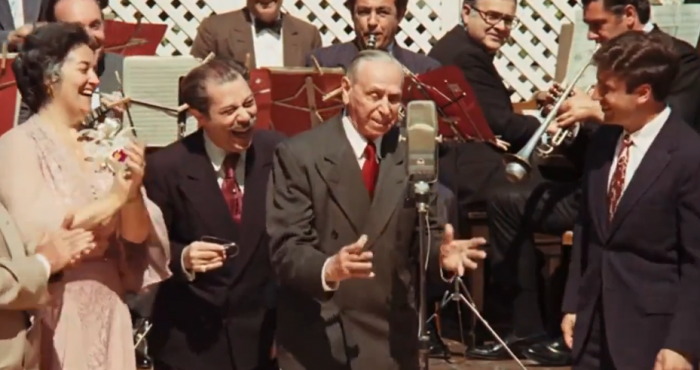
The tragedy of Vito owes to the crisis of succession. He has some tough hombres working for him, but few can understand or inherit his vision. Besides, his is a family empire, which means he has a limited pool of successors. Sonny, Tom, and Fredo each lack a key ingredient, and whereas Michael has what it takes, it’s not what Vito wanted for the boy; indeed, Michael’s return to the Family is a bittersweet affair as Vito dirtied his hands so that at least one of his sons could rise in the world with ‘clean hands'(in the eyes of respectable society).
Hagen, while smart and alert, is a negotiator without the keen ruthless instincts to keep the family ahead of its enemies. Hagen understands the law and the means, but his loyalty is more conceptual than heartfelt. On grounds of ‘business’, he could advise Sonny to negotiate with the murderer of his father. Besides, even though he’s like a son, he still isn’t a Corleone by blood, and blood matters(as later evinced in THE GODFATHER PART 2 by Kay’s revulsion for the ‘Sicilian Thing’ and killing of the ‘son’). Tom’s arguments are impeccably rational, but it takes something more to be a true family member. Sonny, while tough and masculine, lacks sense. Fredo, while calm and gentle like his father(at least in the first part of the movie before his stint in Vegas), is a dufus. Michael certainly has the goods, but he too lacks something the old man had in spades: A bigness of heart that sentimentally bound so many to the Don.
Vito’s ideal of manhood comprises the best qualities of Fredo, Sonny, and Michael. Someone with Fredo’s cordiality and warmth, Sonny’s toughness and courage, and Michael’s will and vision. But, Sonny is a baboon and Fredo a puppy, and Michael has too much venom.
Vito insists on Sonny’s presence when he lectures Fontane about what it means to be a man. Sonny’s idea of manhood is a dumb joke to Vito. Vito has a soft spot for his godson Fontane but what a knucklehead he turned out to be, getting into a mess by falling for some cheap floozy. And, the wedding isn’t exactly a cause for celebration for Vito who feels Carlo is a poor choice for groom: Just a good looking hunk who wants a piece of the family pie. That Sonny introduced Carlo to Connie doesn’t do much to increase confidence in his first son. In this sense, his older sons ‘betray’ him — eventually Fredo turns into a stupid playboy in Vegas and Hagen handled the hit on the Don rather impersonally — while, ironically, the rebellious Michael turns out to be the most loyal, but then he ends up expanding the empire at the expense of the family in Part 2. (Hagen is amused by Sonny’s sexual antics in the washroom and with the Don’s scolding of Fontane. It’s this cool quality that’s both a strength and weakness with Hagen. Hagen gets everyone but has no fixed ethical center. He can as easily get along with horny Sonny as with the prudish Vito. In this sense, he’s not only a problematic war consiglieri but a poor consiglieri, period, for such a position requires not only lawyerly knowledge but a kind of compass for the Family. Hagen needs to be more like Tango in Akira Kurosawa’s RAN.)
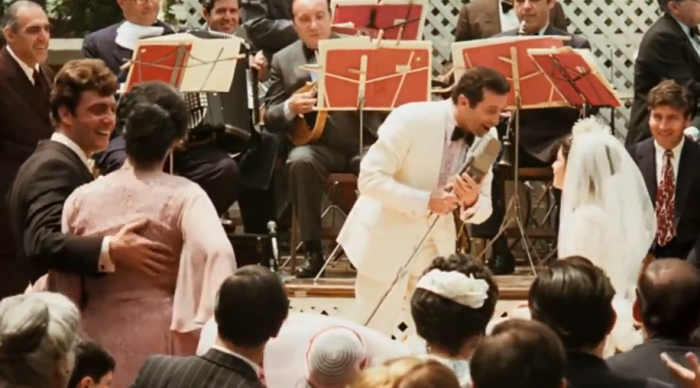
Vito likely worries the Family doesn’t have much of a long-term future with these fellas(prior to Michael’s return, anyway), not when he’s up against real men like the masterful Barzini and Sollozzo the ‘Turk’. As Deke Thorton said to the ragtag bounty hunters in THE WILD BUNCH, “We’re after real men and by God I wish I was with them…”
Sollozzo the ‘Turk’ later says of the Don, “With all due respect, you gotta admit the Don was getting soft.” But then, Sollozzo’s impression of Michael as a softie civilian proved a fatal error on his part.
At the wedding, Clemenza asks Paulie for wine and tells him to take a look around, but it’s Clemenza whose guard is down, in effect, asking a fifth columnist to act as security. This is rhymed with Sonny telling his wife to watch the kids whereupon she tells him to watch himself, but then of course he doesn’t. Sonny’s wife extends her hands to demonstrate the size of Sonny’s dong, and then we see Sonny go off with Lucy, and next we see older folks singing an Italian song with rather naughty connotations as if to suggest young men and women falling in love/ lust is, far from acts of defiance or individuality, is simply conforming to established patterns, a form of supervised child’s play. Few minutes later, as Sonny bangs Lucy the scene cuts to a fat soprano as if to link all of culture and society to basic sexual drives. Most of the relational dynamic in the opening segment revolve around sexuality. Carlo and Connie’s marriage. Baker who wants Enzo, an Italian POW, to marry his daughter. An undertaker whose daughter was nearly raped. Sonny’s jealous wife and his thing with Lucy. Michael and Kay. Fontane driving women wild. Old coot singing some song and making lewd gestures. Vito, like Merlin in EXCALIBUR, is the only one who seems above all this dancing and hairpulling is all about; he has a kingdom to rule. (Does ‘Fontane’ mean fountain? How ironic he has run dry except for womanly tears. He shows up just when Hagen informs Vito that many judges and politicians didn’t show up. This matters a lot for Vito is not just a man who prizes money and power but reputation and respect, one of the reasons he declines Sollozzo’s offer as the already tenuous associations he has with respectable society would be jeopardized. There’s a layer to Vito’s character that is genuinely warm and in need of friendship, and though Vito knows Fontane is a sap and an opportunist, he appreciates the respect.)
At his best, we see Vito’s skill in complementing the various strengths of those around him, making the best of what he has. Sonny is a hothead but hard as a hammer when necessary. He’s the Thor of the Family. The somewhat anemic Hagen is superb with details. Fredo amiably performs his duties without complaint. Clemenza knows how to throw his weight around.
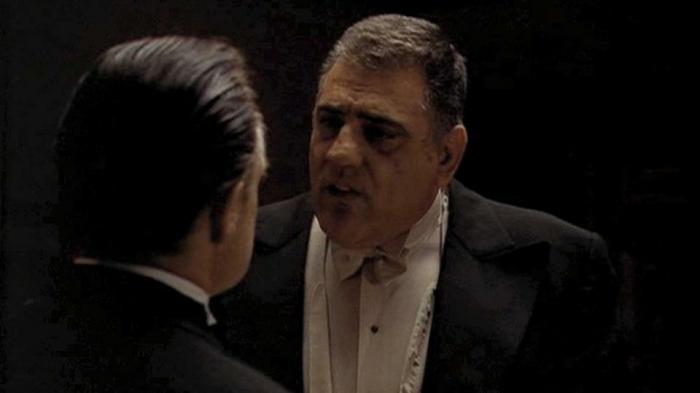
The strangest character in the opening segment is Luca Brasi, the only man who unnerves Vito. There’s something monstrous and brutish about Luca. Kay calls him a ‘scary guy’. He’s like a Frankenstein monster, and Vito is his master, the only man with the key to Luca’s black soul. Luca is almost like an Neanderthal, less evolved than the rest of humanity. He isn’t easily definable as man or beast, Italian or non-Italian, man or child, simpleminded or psychotic. He’s a pit-bull beast obedient only to one master, like Mike Tyson to Cus D’Amato. He’s like a mass of unformed humanity, perhaps what in a Kubrick movie would be the ape-man, the raw stuff from which mankind in all its variations has been carved from. He’s the unmolded clay, unchiseled marble. When he says he wishes the first son will be a masculine child, it sounds as much a curse as a blessing. He tries to make the most dignified impression on the Godfather but the result is crude and primitive, made even worse by kids rushing into the room. But Luca also serves another function. He didn’t expect to be invited to the wedding, but Vito is not a man to slight those who have served him well. Unlike Bonasera the undertaker who had shunned Vito or the politicians who refused the invitations, Vito is a man who honors those who have been loyal to him. (When kids rush into Vito’s room when Luca Brasi is present, Hagen fails in his duties as guardian which again plays out when Vito gets gunned down by Sollozzo.)
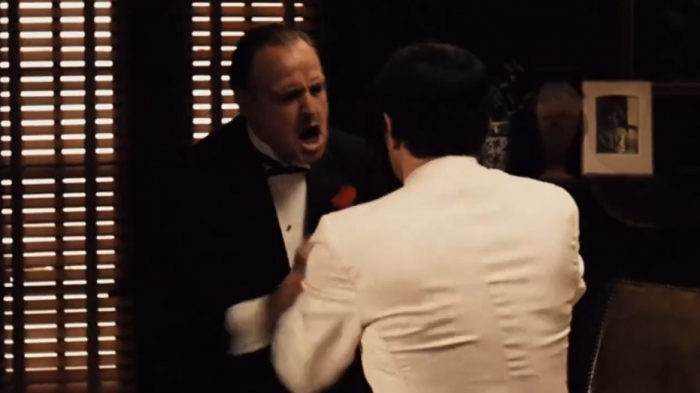
Vito knows there are two kinds of power. The raw kind pushing people around and built on fear, often creating unnecessary enemies and alienating allies. But, if you make many friends, with everyone from looney Luca to a high-strung baker to some ‘Jew Congressman’, there may be unforeseen payoffs down the line. It’s like collecting interest.
For example, consider Enzo(the prospective son-in-law of the baker) who is not a central character nor a member of the Corleone family. But, it’s his gratitude that sent him to that hospital with flowers on that fateful night, which led to his encounter with Michael who used him to bluff as a Corleone strongman, in effect saving Vito’s life. Surround yourself with grateful friends and they might help. Vito Corleone is like the George Bailey(IT’S A WONDERFUL LIFE) of the Mafia. A lot of people he helped would do anything for the godfather.
The following is discernible only in the full-frame versions shown on TV and on VHS. At one point, Vito walks back towards the house, approaching the camera, and then he sticks his finger into the lower right corner of the frame, and then it cuts to Michael(sitting with Kay)being surprised by Fredo sticking his finger to the back of his head. This subtly illuminates what Michael told Kay about how his father freed Fontane from a contract by holding a gun to the back of a ‘band leader’ and making “an offer he couldn’t refuse”. The editing of Vito’s finger with Fredo’s finger to the backside of Michael’s head suggests that the Family is sticking a gun to Michael’s head and making him an offer he can’t refuse; in effect, saying, “Look, Fredo is a dummy, Sonny is a hothead, and Tom isn’t really Sicilian, so YOU Michael got to return and pick up the slack.”